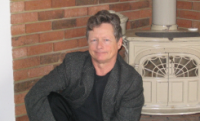
Sharon Fagan McDermott grew up in New Jersey, 4th oldest in a boisterous family of 12 children. She’s a poet, mother, singer, guitarist, teacher and, to pay her bills, an administrator for non-profits. After college, she moved to Pittsburgh and stayed, raising her son, Brian, who is now a freelance photojournalist in New York City. In 2001, she was awarded the Pittsburgh Foundation’s artist award; this was followed in 2002 by receiving a PA Council for the Arts fellowship. Her favorite job was being a visiting lecturer of poetry at the University of Pittsburgh from 2000- 2005. There, in 2005, she was awarded the top teaching award in the arts and sciences, the Tina and David Bellet Excellence in Teaching award. Her first chapbook, Voluptuous, was published by Ultima-Obscura Press (Nebraska). Her chapbook, Alley Scatting, was published in 2005 by Parallel Press (University of Wisconsin-Madison). Her poems have been published in Prairie Schooner, The Seneca Review and other journals.
§
How did you arrive at the writing life?
Nature or nurture, right? I think it’s a mélange of all influences. Writing came easily to me from early on as a schoolgirl at St. John Vianney’s elementary school in New Jersey—diagramming sentences, writing book reports, analyzing stories, writing essays. My grandfather, a first generation American (his parents were from Ireland), loved Irish poetry, especially William Butler Yeats’ work and would recite his poems at all of our family parties. In essence, he is my earliest influence—allowing me to engage with poetry through its original “spoken word” tradition. I fell in love with the sounds of the words, though I didn’t know what many of them meant. Some of my earliest girlhood memories are of trailing my grandfather and his cigar smoke from room to room in his Jackson Heights, NY brownstone as he boomed out, “The Lake Isle of Innisfree” or “Easter, 1916.”
My parents loved music and books and read to us often, encouraging our own love of reading. My father made a living as a writer for a pharmaceutical company and wrote three unpublished novels in his spare time. My mother had been a drama and English major in college, and to this day, she will still correct my grammar when the opportunity arises. My parents first introduced me to poetry as something to be read and appreciated on the page. They bought me all of e.e.cummings’ books of poems when I was a freshman in high school. His joyful language and typography was what first inspired and freed me to write my own poems.
“…once you open yourself up to pay close attention to something,
images and stories are everywhere.”
Finally, as the fourth oldest of twelve children, I craved attention. I started writing as a way to make my small voice heard somewhere, to have a private space in a chaotic household. Once I started guitar lessons at the age of 7, music and poetry became inextricably bound. Writing and singing/playing guitar brought me praise and a small spotlight throughout my school career, even though I was often in the principal’s office for “bad conduct.” I played in local bands and was a finalist in the New Jersey state talent competition, which meant I got to play and sing “Our House” before hundreds of people in our local mall. In both art forms, I found a home of sorts, where I felt most myself and could best express who I was.
And then what?
I went to Glassboro State College in NJ and focused more on being a musician, playing local coffeehouses during the week and in bands on the weekend. It was a very exciting time. Toni Libro, a wonderfully inspirational writing instructor there, created a nurturing classroom environment where we were free to experiment and make mistakes. I loved the cross-pollination of working with artists in all mediums: collaborating with a dance troupe one week or a pianist the next. I married right out of college and had my son, Brian.
Raising Brian, as a single mom, I tried to pass on the traditions of my own childhood—reading to him every night, singing at his pre-school, encouraging his own interest in writing. He is now a remarkable writer (and great guy), working as a freelance photojournalist in New York City. During those years, I knew that I wanted to immerse myself in the conversation and community of writers again, but I wasn’t sure how to fit it all in.
Finally, in my early thirties, I started graduate school at the University of Pittsburgh and received my MFA in poetry in 1994. My writing life was reinvigorated by working closely with an amazing group of teachers and writers. We started a musician/poetry collaborative called The Poetry and Drum Ensemble—14 poets and 3 musicians—and performed at theaters throughout Pittsburgh. Teaching poetry classes during graduate school also confirmed for me that encouraging other young writers to love poetry, to find their own writer’s voice, was about the best job anyone could have. I ended up teaching part-time for a couple of years at Carnegie Mellon University and as a visiting lecturer at the University of Pittsburgh for five years. My poetry students were some of my brightest and best teachers along the way.
The title of your chapbook “Alley Scatting” suggests both music and urban landscapes, the “fringe space”. Was it difficult to sustain this theme?
I wrote all of the “alley” poems in the summer of 2002. I moved to a new, edgier neighborhood in Pittsburgh, because I could no longer afford to live in the family-oriented neighborhood I’d been living in. The first week in my new apartment, two people were shot (one died) within blocks from my home. A month later, the horrifying World Trade Center terrorist attacks happened on September 11.
The world felt tilted, dangerous. I missed my old neighbors. I missed feeling safe. But, I was also intrigued by scenes that played out every day in my new neighborhood—the woman from the Personal Home who made me a bracelet of rubber bands and a small plastic dolphin, the old Polish woman who tended her roses and her mentally-challenged grandson each morning.
And I found myself drawn to the alleyways everywhere in my neighborhood and two adjacent neighborhoods–Bloomfield and Lawrenceville. My beautiful German Shepherd, Buddha, and I began to explore them. (Buddha plays a big role in these poems.)
“I came to see that the poems were not just a literal,
image-driven exploration of these new trash-filled ‘fringe spaces,’
but a darker and harder exploration of my own life.”
—-
The “alley project” started from a writing exercise I gave myself. I was teaching at the University of Pittsburgh at the time and had the summer off. I decided to write a syllabic poem every day based on whatever images I found in a particular alleyway at any given time. There was something about the rigidity of the ten-syllable line up against the gritty unpredictability of the alleyways that fired my imagination. (By the end of the revision process, very few lines in the book ended up being ten syllables long.) This was the first time I disciplined myself to write every day. Usually, I was a “catch as catch can” kind of writer, grabbing minutes or hours here and there.

Sharon & Buddha
I’d walk Buddha armed with a little pocket notebook and take notes about whatever was happening in a particular alleyway. And, as often happens, once you open yourself up to pay close attention to something, images and stories are everywhere. Sometimes the images were dramatic: on the morning after we had a “microburst,” a tornado-like storm that tore through our neighborhood ripping up huge old trees and half the telephone poles down, the roads were all blocked. No one could drive in or out for weeks. Sometimes it was the “character” in the alley who drew my attention— the sorrowful-looking transvestite who seemed to always be leaning against a fence in an alley at a particular time every afternoon, for instance. On one occasion, a man ran past me, smoking fast, holding a gun. He had just robbed the corner 7-11. (I was glad to have my 130 pound German Shepherd barking at my side.)
What had started as an exercise turned into an obsessive project that filled the entire summer. I wrote a poem a day, though many did not make the final cut into the chapbook. And, after a while, I came to see that the poems were not just a literal, image-driven exploration of these new trash-filled “fringe spaces,” but a darker and harder exploration of my own life. I had arrived at my own in-between world, having suffered the deaths of my brother and father, the “loss” of my son now grown and off at college, and I was struggling with what it meant to be a single, middle-aged woman in America.
There also seems to be, in the midst of the decay, a search for beauty—blossoms, gleaming new items—those small points of contrast.

Photo: Maryann Donovan
Earlier this month, I heard the poet Robert Hass give a most remarkable speech at Chatham University about environmentalism and artists. He was challenging the writers in the room to create the arguments and stories that might stir “America’s moral imagination” again so that people come to value every individual life, to see the interconnections—from the human being to the crane to the polar bear. One of his own arguments was this: That our lives have a “constant element” to them—the day-to-dayness of our work and family lives which is thrown up against the “variable element” of life. He stated adamantly, “That variability in life, with its richness and beauty, is what our lives depend on!”
I have always been invested in and captured by what Hass calls the “variable element.” I am much more interested in the beautiful things that make us different from one another and in celebrating them, than in this constant move to homogenize everyone: “look we’re all exactly the same underneath.” I am daily amazed by the overwhelming diversity in nature—no two leaves falling this October look exactly alike—the endless and unique patterns of color in each make me grateful.
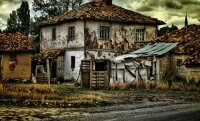
The beauty of the alleyways lies precisely in this mysterious variability—anything could happen there “away from peering eyes.” Alleyways could be both dangerous and great places for kids to play; lilacs could grow up against overflowing dumpsters; there might be an old Italian woman sweeping there one day or a tattooed boy from the local Giant Eagle making out with his girlfriend the next day. Also, alleys are the taken-for-granted passageways for the neighborhood. I was interested in pausing and seeing the life that takes place in these hidden spaces. Emerson once extorted Americans to pay attention to their own backyards and the richness there. This is equally true for urban dwellers as those in bucolic, postcard settings.
“Plague, Eden Way” Photo: Maryann Donovan
Finally, I’ve often returned to the line in William Carlos Williams’ famous poem “The Red Wheelbarrow.” I think it is the key to the poem “so much depends upon…” I love that he is putting so much weight (and thus, imbuing them with beauty) on a “mere” wheelbarrow and the chickens—“so much depends upon…” —these small things we fail to pay attention to, these small lives we take for granted. Stopping everyday in these urban “ruins,” where judgment and restrictions are suspended, invites small stories to spring up from the cracks. By the way, one of my favorite outcomes, from publishing Alley Scatting and doing some readings of the book, is that my alley poems inspired poetry classes to do writing exercises in the alleyways, and also some local photographers, inspired by the idea, did photo essays of the ways.
Readers may notice references to your own life, in a few of the poem dedications, and in a poem where a neighbor comments on your name—what’s the balance between the autobiographical and the “truth” of poetry to you?
Great question! But, complicated. Certainly, there are factual, verifiable descriptions of some of these alleyways in my poems, for instance. If you walk down Eden Way in Lawrenceville, the word “Plague” is still spray-painted there. You can still spy the odd stained-glass window in a church where Christ’s face is blotted out at one end of St. John’s Way. Initially, the images in the poems did arise from an almost journalistic observance of the alleyways, their details and characters. Also, events in my life did put pressure on some of the poems or were directly grappled with in others: for instance, my grief at my younger brother, Brendan’s death from cancer and my father’s death influenced the tone of a lot of the work. Brendan’s “ghost” seems to haunt quite a few of the pieces; he is the “ghost”next to me in the last poem for instance. But, it’s also true that I turned a “real” rollerblader into a kind of sensual song, and that I invented the Italian immigrant in Rosina Way, based only on the alleyway’s sign and location in a predominantly Italian neighborhood. It’s the synthesis of all of these elements—fact, imagination, instinct, perspective, language play, the heat of the sun in August, my dog’s need to go to the bathroom, the demands of a syllabic line, etc.—that create a new truth, less based on facts, than on the emotion or idea or song that rises up from this potent combination. I think, what we call “voice” in a poem is the arrival at that confluence (to use a river image here in the three-river city) where all of these elements flow into a new channel that is surprising and illuminating even to the writer herself. I found myself very happily surprised by the direction that many of these poems took.
“But I’m old and they’re young/and I speak a barbarous tongue”—the reference to Yeats appears in one poem, and in other poems there’s also a great respect for the older Italian women in Pittsburgh—do you have a sense that your work is giving voice to characters not often seen?
This chapbook was the first time that I worked so closely with “characters” in a poem. I was very apprehensive, at first, when these people started “showing up” in the alleyways in my poems. I’m a lousy fiction writer (did try it quite a few times), and I wasn’t sure I was up to the task of handling character in my poetry. I became invested in writing the stories of those who were going about living their everyday lives. For instance, I never wrote a poem about the high drama I came upon in the alleyways (e.g, the robber from the 7-11 being chased by the police) though certainly the event seemed to call for it. I never wrote the poem for the young, good-looking football players tossing the ball in one of the alleyways. My imagination was much more engaged by those that seemed more hidden, who were leading quieter, less showy lives. After all, the alleyways were the perfect vessel to hold those living a little more on the edges of mainstream society.
Are you currently circulating a book manuscript? What has the process been like?
I’m not overly fond of Po-Biz, the submitting of manuscripts, individual poems, the constant competitions. The poet Jean Valentine, one of the most generous, lovely souls I’ve ever met, who happened to be teaching one semester at the University of Pittsburgh, gently chided me over lunch one day, saying, “Aren’t you ambitious? Don’t you want to see your book in print?” At that point, I was hardly sending manuscripts out. I have become more systematic in my approach since her pep talks—and try to keep sending out on a regular basis. But, it seems terribly odd to me that poetry manuscripts, of all the genres, need to compete against hundreds of other poetry manuscripts, rather than be championed by an agent, like fiction and non-fiction manuscripts.
–Also from Sharon, No Name Alley
If any genre needs a champion to “sell” it, it’s poetry! Also, poetry demands more quiet contemplation from a reader, a chance for an editor to read and re-read, and a chance to grow on someone, I think. The chronic, grinding competitive arena for publishing a book of poetry seems the antithesis of this. That’s why I do try and research which publishing houses have open readings, so that I can at least explore this avenue, too, where a manuscript might have a shot at being read by an actual editor.
“…poetry demands more quiet contemplation from a reader,
a chance for an editor to read and re-read,
and a chance to grow on someone …”
That being said, I was lucky with my Alley Scatting chapbook. It was a finalist in the first contest I sent it to and was published by the second one, Parallel Press of the University of Wisconsin-Madison. My whole manuscript, however, is a different story—probably a more typical writer’s story—Urban Pastoral has been circulating in competitions and at open submission readings for two years.
It was a finalist in one competition; but I have received the piles of generic rejection slips since then. I guess my question becomes, after how many rejections should a writer return to her manuscript and retool it to make it more marketable? Or do you just keep sending the same one out for years and years hoping it will find its publishing home? I’ve already answered this for myself; I’m revising the manuscript, adding in new poems, pulling poems I now suspect are the weaker links, and hoping that this particular version has more luck.
What are some of your influences?
I think I listed a lot of influences in my first answer. But, there are other influences. In graduate school at the University of Pittsburgh, Lynn Emanuel and Toi Derricotte were generous, challenging, fiercely intelligent readers and mentors of my work. I am ever grateful for their support, keen eye and essential humor as we worked together. In the summer of 1996, I worked with Yusef Komunyakaa at the Fine Arts Work Center in Provincetown. My brother, Brendan, had been buried only a week before this, and Yusef not only shared amazing critiques and advice on how to be a better writer, but was so caring and generous, taking my grief-stricken self to breakfast each morning, that I also learned a lesson about deep kindness from a great man. I learn a lot from constantly reading the work of modern writers. I return, over and over, to these poets’ work: Louise Glück, Robert Hass, Dean Young, Sharon Olds, Campbell McGrath, William Carlos Williams, Gabriel García Lorca, Neruda, Mark Doty, Lucille Clifton, Frank O’Hara, Lynn Emanuel, Yusef Komunyakaa, Tim Siebles, Joy Harjo, Larissa Szporluk, Susan Mitchell to name a few. Yeats is always by my bedside table and I go through periods of needing to re-read out loud Dylan Thomas’ work or Walt Whitman’s Leaves of Grass. (My new dog, Rosie, has heard more poetry than she probably cares to.
“…poetry is a living art, a gift we are able to share,
made of our breath and bodies and the weight of language. “
Music has always influenced my work. I’m very interested in making the poem sound musical and making sure that the music of an individual poem fits the content of the poem. To this end, I always read my work out loud when I am revising it. I like to go “by ear,” rather than using an established form. I’m interested in how the line break and white space can influence the rhythmic and lyrical intensity and variety in a poem. Toi Derricotte cautioned me (wisely) to watch out for my love of the musical line—there are times I’m sheerly out for the play and musicality and I forget all sense of “sense” in a line. So, I work to balance what I want to say with the musical way I want to express it.
Just recently, I’ve started merging my poems with song lyrics. At a recent reading at the Carnegie Library in Pittsburgh, in front of 70 people, I read/sang one of my new hybrids—part poem, part the lyrics of Billie Holiday’s “Weeping Willow Tree.” It seemed to be a big hit, and a member of the music department at a local university urged me to record it. Now, these poems may not work as well on the page, but I’d love to keep writing them for performing out loud.
Though I may balk at “Po-Biz,” I absolutely LOVE to read in front of crowds. It is one of my regrets, right now, that I don’t have a full manuscript published yet, because I want to be invited to read—anywhere, everywhere. The oral tradition of performing poetry is very exciting to me. I may not carry a lyre, but I keep my guitar nearby for some of the pieces. I want the words to come to life for audience members. I like when the audience reacts, yells out, starts swaying or laughing or sometimes, weeping. That exchange reinforces to me that poetry is a living art, a gift we are able to share, made of our breath and bodies and the weight of language.
–Also from Sharon, Poem for April
–
Karen Rigby is the former Poetry Editor for Emprise Review and currently edits Cerise Press.
the images in the poems did arise from an almost journalistic observance of the alleyways, their


Pingback: Celebrating Adrienne Rich « Serenity in the Storm