Abandoned Rooms

Indira Chandrasekhar

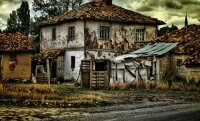
Do the abandoned rooms have any memory of the fertility they once housed? The humidity of bodily activity seems to have left no trace. What I can see of the walls through the gaping panels of the doors, most of which hang off their hinges, is dry and crumbling. How do people who live around here pretend the building is—has ever been—benign? I cannot pass the government-yellow edifice fronted by the dreaded row of insemination chambers without staring into those empty spaces.

The wall separating the sea from the land is covered with grey dust, as if the wind has lifted traces of the rooms and deposited them here. It is high tide and the view is beautiful, the vileness that washes down from the city masked by the sparkling water. Unlike the holiday revelers however, I face landward, my eyes and mind drawn to the open doors. Young families glance at me as they stroll by on the paved boardwalk, and mothers hold their children close – I don’t fit, I don’t belong. They don’t know that I may carry life inside me.

I’ve been here before, with my mother. ‘You were born here,’ she’d whispered, holding my head in her claw-like hands as I bent over awkwardly. I remembered it as a bleak and inhospitable spot dominated by the government breeding facility. No people around, the few successes nurtured desperately behind closed doors, the failures driven out. But as the population climbed back up thanks to the activities of the Centre, three- and five- story flats were built in the streets behind, the Centre’s operations were shifted out of the city, the rotten, organic debris of unsuccessful experiments was cleaned up, and the garbage cans began to get cleared twice a day. Now even the people from the fancy homes overlooking the sea—the ones the Centre was built to serve—come walking here.

I stop a woman a little older than myself and point to the building. I want to ask her–what do I want to ask her. I just want her to acknowledge the building’s presence. She makes a pretence of looking over at it but I see that she closes her eyes as she turns, as if to shut out the image. Her fingers are short and tired and the veins on the back of her hand are prominent. She presses her palm to her abdomen, shakes her head and hurries on, and bent as if our brief encounter has aged her. A child runs up to her, calling, and reaches for her hand. I see the woman begin to relax. As she and the child walk towards the balloon man, her step visibly lightens. I cannot see her face from here, yet I sense she is smiling.

I too place my palm on my abdomen, almost feeling the denseness that could be. I too feel like smiling.

‘Sheena, Sheena.’ I hear my name being called. It’s Kuké. She looks ghastly, poor thing, her hair sparse, the muscles on her face stretched into a sort of permanent grimace. Unlike me – it isn’t easy to pinpoint why I am different, only that I am – she is identifiable as one of the failures. Kuké’s eyes are shining, her face struggling into a grin that beams at me. ‘Are we the first? I ran from the station. I knew you’d be early.’ She flaps her arms about and her purple-pink sleeves look like fine insect wings. I get up and hug her.

Obviously they haven’t announced that there is going to be a reunion of the failures at the Centre today. First of all, they don’t know what to call us, any term can lead to a lawsuit about discrimination. Also, they don’t want to scare away the tourists in this nice weather: come enjoy the sunshine with a bunch of infertile freaks! Most of the people enjoying the walk live inside the gates. They’ve never seen us rejects except through the windows of their vehicles when they cross to other suburbs. As we gather, their children stare, their eyes so wide that they look like those pictures of lemurs I saw in the ENL – The Earth’s Natural Life Museum that we were taken to from school. I thought then–it was before I went through my development programme so I didn’t yet know what I was good at–that it would be fun to try and grow one of those or at least to draw them. I love to draw even though they told me that I don’t have an aptitude for it. They placed me in office work. It’s dull but much better than the other dreadful tasks I could have been assigned such as cleaning excrement, dismembering the dead, or worst of all, planting the seeds. I couldn’t live with the pain and the screaming and the knowledge that most of the carriers and most of the embryos will die. It is no surprise that so many failures break from the system.

Despite everything, I haven’t broken from the system. I did think about it and went to see Kuké at her place. The shacks spring up everywhere, on the edge of the sea, behind the apartment blocks, on the hill-side, like mushrooms, clinging and pushing, fragile yet dense, their dark crevices filled with damp growth. Kuké’s shack overlooks the bridges, hanging off the side of the cliff. The place smells of urine. I compromised freedom for clean space – office work is dull but it gives me time.

It was two years ago that I first spotted. The drop on the grey-white bathroom floor was red and round with a trellis of splash marks. When I had gone to see my mother just before she died she’d clutched my tunic, pulled me towards her and said, ‘You can breed, you’re not a failure. You can breed.’ Her breath was foul and she looked like a charcoal drawing, black and powdery, full of shadows and lines. ‘They threw you out because you’re a half-caste. You can breed.’ I was accustomed to her crazy whispering, I seemed to set her off much more than the others who had come out of her womb. ‘Half-caste – I lay with your father, a worker, it was beautiful. I fooled them. I let them put a seed in but I syringed it out before it took so you could grow. Don’t forget, you can breed.’ I’d concentrated on extricating my tunic from her fingers. Even though it seems inconceivable that she could have managed an uncontrolled insemination, I wonder now? Failures are supposed to be infertile but my body tells me I am not. I can make life.

I learnt from Kuké that I am not the only one. We are mostly female, about the same age, without caste of course, excluded from the social structure, most of us products of this breeding centre. They didn’t scissor the organs out of us but kept us in control with hormones and toxins. Either we were part of a test group, or somebody decided to spare us. Nobody knows why we weren’t kept with the caged breeders who are maintained in case the latest engineered beings with their emotional-balance and disease-resistance genes ever fail to reproduce. Nobody knows how or why we were released. Perhaps they thought they’d successfully suppressed our reproductive systems, perhaps they presumed that we’d been transformed into failures. But our bodies have rebelled. They want a part of life.

My mother used to beg us to spend time with her. ‘You were in my body, I miss you,’ she would say. Every now and then she would arrange a reunion. ‘A family picnic,’ she called them, even though we never the left the lonely room in which she lived. Excited and happy in a floaty white dress or a bright plastic flower necklace she would try to hug each of her ‘children’ as they were brought in. Only Kuké and I ever reciprocated. My mother would organise party games or we’d have to sing or dance. The worst was when she took out the infant pictures, showing us images of small, shrivelled versions of ourselves. She would linger over my picture and touch my face and weep. Strangely, even though the gatherings were so sad and disjointed most of us still came to them long after we were forced to comply. Including the ones who were most uncomfortable, the ones who carried none of her genetic material, the surrogates, we called them, who had been planted for her to carry. One of the tenets that we are taught at every training session is that the basis of love is to maintain the species and that if you can’t breed you lose the ability for love. But all of my poor mother’s children, most of us failures and outcastes who cannot breed made it to those awkward ‘family’ events.

That one time I saw the Centre with my mother, she had insisted we went for a walk along the dirty, disintegrating cement walk. The debris against the sea wall stank of rotting flesh. Three units in the Centre still functioned then, the noise from the engines made a low hum. As we’d approached the place my mother had begun to shiver and clutch her abdomen. ‘The needles,’ she’d exclaimed and described the needles they used in the insemination and the planting. ‘Kuké, just like my sister, Kuké has same smile,’ she cried and said, ‘My sister, third planting, needle broke, they couldn’t lose the child, important specimen, high caste. Child lived, she died. My sister, a virgin, died in childbirth.’ As we walked away from the Centre and stood looking out on the water she had turned to me slyly and said, ‘I am not a virgin. I lay with a man I loved.’ She’d stroked my face. I hadn’t believed her.

Do I believe her now? I don’t know, but she was right about one thing, I am capable of breeding.  I’ve tried for a year to make a life, I’ve lain with every male that the breeder group has in their list but to no effect. ‘It’s because there is no love,’ says Kuké. The others don’t know what she is saying but I think of my mother and think perhaps Kuké is right.

I look at the group gathered here. We have told the authorities that we are here to pay tribute. They don’t believe us but they’ve given permission, they have little to lose even if the group succeeds in what it intends to do. The place has been de-activated, it is a liability, a bad memory and they can suppress the news about the agitation. Kuké and the others don’t care. They want to destroy the place.

I wish they hadn’t closed the Centre down, and I hope it won’t be destroyed today. I want to have a chance to conceive in a place like this. I had no option but to try the illegal insemination shop in the shanties, so dark and dirty. Was it successful, has it taken, it is too early to say. It is possible I carry a life inside me. The sea is retreating now, revealing the horror that has accumulated underneath. I don’t look. I want to keep my mind clear.

Indira Chandrasekhar started writing fiction with an increasing focus on the short story upon returning to India after more than 17 years abroad. She has a Ph.D. in Biophysics and prior to committing to fiction writing she studied the dynamics of biological membranes at research institutes in India, the United States and Switzerland. Indira is the founding editor of Out of Print, a new online literary magazine for short fiction from the subcontinent. Her work has appeared in places like Eclectica Magazine, The Little Magazine, and in the short story collection, Vanilla Desires, from Unisun Publications in whose annual competition she received recognition. Links to her published stories are available on her blog, Indi’s Blog.

→EMPRISE 16

Comments are closed.